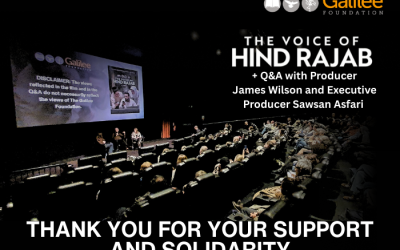
Thank you to everyone who joined our charity screening of the extraordinary Palestinian film, “Alam.”
Also, a big thank you to acclaimed director Firas Khoury, who took the time to answer questions from the audience following the screening of this incredible coming-of-age Palestinian film of oppression, resistance, and personal realisation.
Below we have uploaded the full video for you to watch:
Below is a truncated transcript of the entire Q&A:
Q&A with Firas Khoury
Maha Alfarra, Managing Director Of The Galilee Foundation
Thank you everyone for staying with us for the Q&A. We’re very happy to be joined by Firas Khoury. Thank you so much for being here with us today.
I’d like to start by asking you about the origins of the film. What was the initial spark that led you to tell this story, and how personal is it for you?
Firas Khoury
Thank you for having me, and thank you all for watching the film.
The idea for the film came from my own experiences growing up, particularly in relation to school, authority, and the unspoken rules that shape your life at a young age. I was interested in exploring how political realities enter the lives of teenagers, often without them fully realizing it at first.
For me, it was important not to make a film that explains politics directly, but rather to show how it exists in the background of everyday life — friendships, school, family, and the choices you make when you are still trying to understand who you are.
Maha Alfarra
One of the striking elements of the film is how it captures adolescence — the uncertainty, the bravado, and the desire to belong. Can you talk about working with the young actors and how you approached those performances?
Firas Khoury
Working with the actors was one of the most important parts of the process. Many of them were very close in age to the characters they were playing, so they brought a lot of authenticity naturally.
We spent a lot of time rehearsing, but also talking — not just about the script, but about their own lives, their fears, and their experiences. I wanted them to feel ownership over the characters, not like they were simply performing lines.
I also allowed space for improvisation. Sometimes the most honest moments came from things that weren’t written but felt true in the moment.
Audience Member
Thank you for the film. I was wondering how the political context influenced the way the story unfolds, especially since it’s not always explicit.
Firas Khoury
That was very intentional. I didn’t want the film to feel like a lesson or a statement that tells the audience what to think.
Politics are there because they are unavoidable in that context, but they are experienced through small moments — a look, a rule, a limitation. For young people especially, these things are often felt emotionally before they are understood intellectually.
The film is about that slow realization.
Maha Alfarra
There’s also a strong sense of tension throughout the film, even in quiet scenes. How did you work with sound and pacing to achieve that?
Firas Khoury
Tension was something we focused on from the beginning. Even when nothing dramatic is happening, there’s an underlying pressure that the characters live with.
Sound design was crucial. Silence, background noise, and what you don’t hear can be as important as music. We wanted the audience to feel what the characters feel — that constant awareness that something could shift at any moment.
Audience Member
How was the film received locally, and what kind of conversations did it start?
Firas Khoury
The reactions were very emotional. Many people saw parts of their own lives reflected in the story, especially the younger audiences.
What meant the most to me was hearing people say they felt seen, or that the film put into words feelings they hadn’t been able to express before. That’s always the hope — to create space for conversation rather than closure.
Maha Alfarra
Thank you so much, Firas, for sharing your insights, and thank you to everyone here for your thoughtful questions.